Team
The people behind
the brain.
A small, cross-disciplinary team building a brain-inspired AI for robots. Deep expertise on the architecture, paired with the operational footing to scale it.
Our approach
We don't scale a frozen model. We grow a brain, grounded in decades of computational neuroscience.
Grounded in neuroscience
Every mechanism maps to established research: spike-timing plasticity, BCM theory, eligibility traces, and neuromodulation. Not a metaphor for the brain, a working model of one.
Learns from experience
Like a child learning to catch a ball, the brain rewires itself with every try. No hundred-million-dollar training run, no frozen weights. It learns from outcomes, not curated datasets.
Grows up in stages
OSCEN develops through five stages, infant to adult. Each phase prunes, myelinates, and consolidates, changing what it can learn next while older skills stay intact.
Efficient, and body-agnostic
Event-driven spikes compute only when neurons fire, so it is built to sip power instead of burning it. Cameras, microphones, motors, speakers: built body-agnostic, so a new body is a manifest and a plugin. The brain is the product, the body plugs in.
Who's building it
Founders and researchers behind OSCEN.
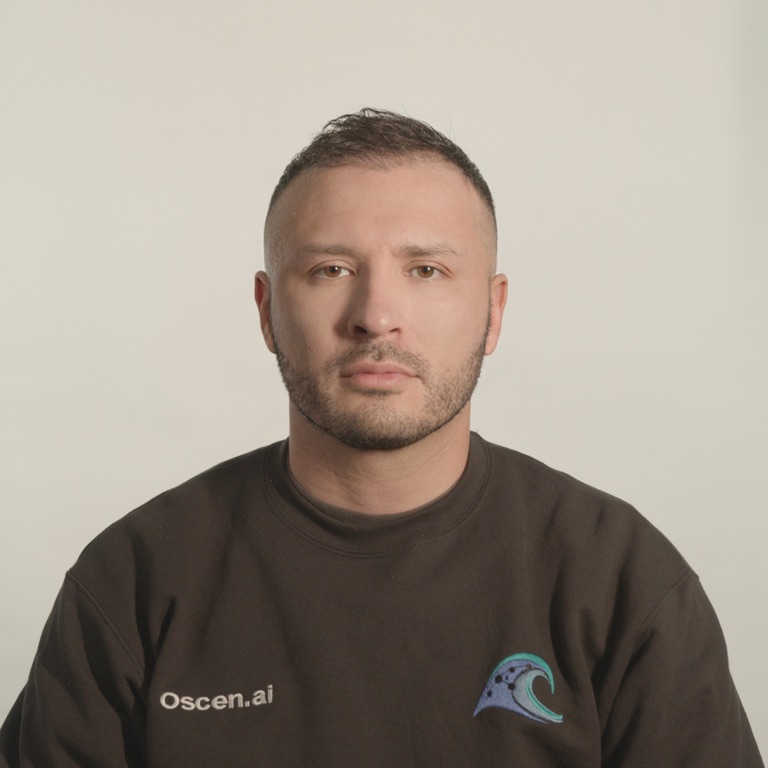
Rio Bold
Cofounder & Architect
Marine Corps veteran. 13 years of professional software engineering across multiple Fortune 500 companies, building AI integrations, enterprise business processes, and full-stack systems at scale. Combined with nearly a decade of independent research in computational neuroscience, distributed systems, and real-time sensor fusion.
5 years of planning and architectural design, then 7 months of focused build to bring the complete OSCEN architecture from concept to 1M-neuron deployment.
Domain expertise: Spiking neural network theory, STDP/BCM learning rules, sparse matrix computation (CSR/COO), real-time event-driven systems, neuromorphic hardware constraints (Loihi, SpiNNaker), robotic motor control, and sensor fusion pipelines.
Every architectural decision. Every learning mechanism. Every line of code. Sensory gateway, brain simulation, motor output, cognitive action channel, speech motor, developmental phases, persistence layer, monitoring pipeline, and 5,000+ automated tests.
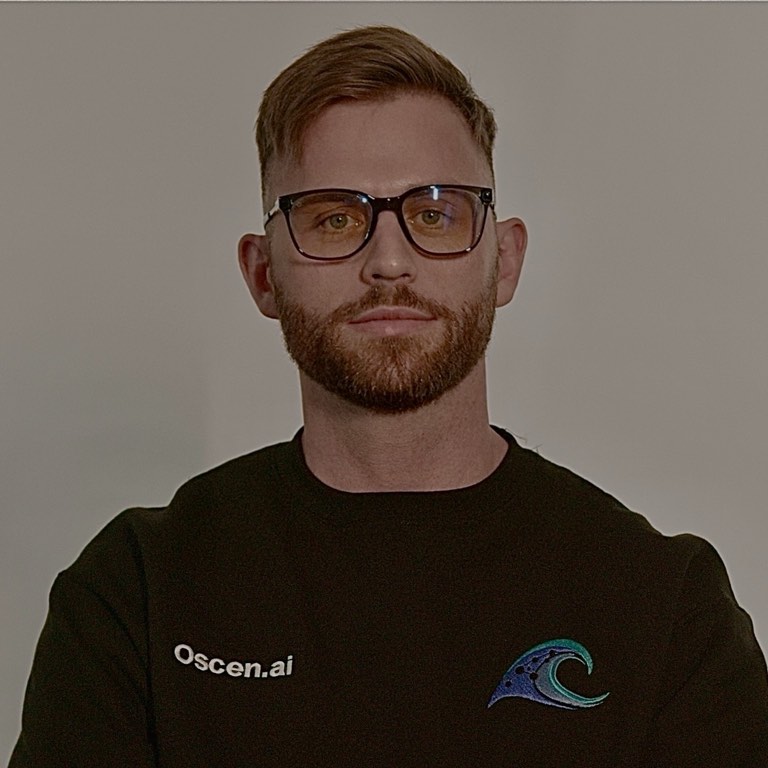
Adam Hamersky
Cofounder & Operations
Marine Corps veteran with a record of leading people and running fleets under pressure. Served as Chief Motor Pool Dispatcher for the 7th Marine Regiment, coordinating personnel, vehicles, and mission readiness against tight operational windows.
Brings that same discipline and mission focus to building the brain that will move the next generation of robots, turning architectural ambition into a fundable, hireable, deployable company.
Operating focus: fleet logistics, program management, partnership development, and the operational footing required to take OSCEN from research artifact to commercial deployment.
Every operational decision. Every hire. Every milestone. The mission discipline that keeps the build on track.
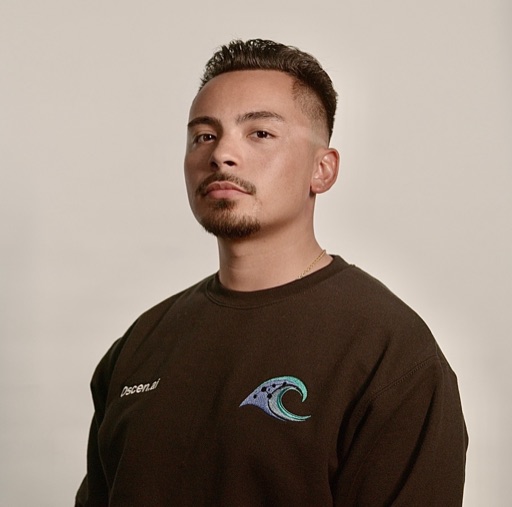
Robert Robancho
Partner, Intelligence & Threat
Marine Corps veteran with a record of evaluating and neutralizing asymmetric threats in high-stakes environments. Built foundational expertise in tactical military intelligence, reading adversary intent under time pressure and translating ambiguous signals into defensive posture.
Transitioned to the consulting sector as an analyst at Deloitte, where he led complex operational logistics and data tracking for United States Space Force contracts. Recognized with the 2026 Charlie Allen Achievement Edwin Land Industry Award for outsized impact on the national security mission.
Operating focus: intelligence frameworks, threat modeling, OPSEC discipline, security clearance management, and hardening emerging physical AI platforms against modern vulnerabilities. Bridges ground-level tactical realities with high-level strategic intelligence.
Every intelligence assessment. Every threat surface. Every hardened deployment. The OPSEC discipline that keeps the architecture defensible from day one.
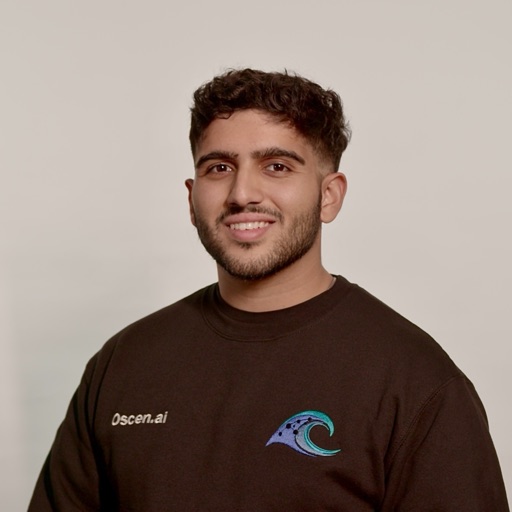
Sully Regmi
Research Scientist
Neuroscience and emotion-science researcher. Holds a degree in neuroscience. Studies how emotion and social judgment arise from neurocognitive processes at UC Santa Barbara's Yu Emotion Science Lab, with earlier work on visual attention and eye-tracking at UCSB's Vision and Image Understanding Lab. Brings that grounding in how the brain processes signals together with a machine-learning practice across natural language processing and computer vision.
On the OSCEN team, contributes on the speech and language side, connecting how biological auditory and speech-motor pathways learn to the platform's spiking implementation, and supporting the research program and experimental validation.
Research focus: natural language processing, computer vision, emotion and affective modeling, and reproducible evaluation of the learning system.
